Monday, July 26, 2010

Two events

Our field season has become increasingly busy over the last few weeks but I wanted to take some time to talk a little about two events we have had here in the last 10 days.

EVENT 1: Research in Action Tour

Each year the CNSC staff organize a community bus tour of the research based out of the CNSC. The bus picks community members and visitors to the Churchill area up from town and brings them to several research sites before ending the tour at the centre itself. This lets people from outside the CNSC see what researchers are up too and ask questions about how the Churchill landscape is affected by research. It also gives researchers a chance to improve their communication skills and see what eachother are up to as well (because believe it or not with everyone running around trying to get their stuff done, it is possible to go almost an entire field season and not know what every project entails). This year we heard about zooplankton, semipalmated plovers, aquatic insects, mites and the effect of snow cover on shrub encroachment. We had great weather and an awesome turn out! My site was the first on the tour and it was great to be waiting there and all of a sudden have 2 buses and a convoy of vehicles show up!

EVENT 2: 2nd Annual CNSC Science Olymp-a-thon

The Olymp-a-thon is a way to get everyone together for some science type fun and a bit of healthy competition. Using a random number generator, the researchers were split into teams of 4 and competed in a mascot competition using stuff from our "free for all" shelf, a find the hidden chick contest using pictures from the field (thanks JR and Francois) and a chest wader relay, followed by some casual horseshoes and a bonfire.


As you can see the competition gets pretty intense...


During our bonfire that night, we were treated to the magnificent aurora borealis, reminding us all why scientists first came to Churchill in the first place (well one of the reasons)!


Thanks to Leeanne Dunne and Andy Jonhson for the pictures this time around.

Friday, July 16, 2010

The way things go...

With the Research in Action tour happening in a few days I have been thinking about what I would like to tell community members and visitors about my study sites and project. While I will most likely explain my question, talk about the uniqueness of the bluffs and show them some fun swimming zooplankton, there is actually much more that I would love to say.


For instance, I would love to share one of the reasons that I love science and field ecology in particular...and that is that there is always something new to think about or improvise. Even when you think you have found an answer, a new question or challenge will pop up (and I say this in the most optimistic way possible).


This year we are collecting data for an undergraduate project focusing on phytoplankton communities and co-occurrence with zooplankton on the rock bluffs. I think that this is an important part of the ecosystem that we have yet to touch on during our studies in Churchill, and after reading several papers on functional traits of phytoplankton and how these can impact multiple trophic levels I was determined to collect data for this project.


Enter problem 1 and 2: how do you collect something that you often can't see with the naked eye (but that should be everywhere) and secondly, how do you go about identifying said organisms.

Well, the identification is a work in progress but we now have the study up and running on 5 different bluffs using 2 collection methods. One involves a simple bucket and plankton net method, capturing and concentrating the phytoplankton in much the same manner as we collect zooplankton.


The 2nd method involved a bit more improv and some outside advice. After studying an apparatus used by another research group to study algae colonization, we contructed and deployed several film traps, basically floating traps with secured plastic film designed to have phytoplankton accumulate on it.


We have had a few friends come out with us to the bluffs recently (most likely because of our propensity for seeing polar bears...7 today alone), and several have taken some great pictures of the phytoplankton project so I will post those soon.


Until then, here is myself and Kuz sorting some zooplankton.


Brittany has been here for a week now and will add a blog on her first impressions shortly! Tomorrow is Parks Day and we will venturing across the Churchill R to see the Prince of Wales Fort. Expect a post on that, the Research in Action Tour and the upcoming CNSC Olymp-a-thon shortly!

Thursday, July 8, 2010

Serious science (sort of)

I've become convinced that a field season is about more than just your own research project. One of the many things that I love about the CNSC is the chance to experience other types of science. Not only is this an amazing learning experience but it really opens your eyes up to happenings in the scientific world...something undoubtedly important for any young grad student. Last week I had the opportunity to learn more about the world of ornithology, when I ventured into the field with my friend Anne, a fellow researcher from Trent University. Anne studies semipalmated plovers and killdeers. She is interested in how climate change may affect plovers as killdeer move north and overlap the plovers' range.


Watch out birders, I have now banded 3 birds! It has been really interesting to learn more about this study...with my research I am very focused on community level ecology and on abiotic processes as well to a certain extent. To learn more about how science is done at the population and behaviour level has been really neat.


Being in Churchill also provides you with some unique recreational opportunities. On Canada Day, several researchers braved the cold waters of Hudson Bay to participate in the annual Bay Dip, a relay race into Hudson Bay.


We are preparing for the CNSC's annual "Research in Action" tour so expect an update on that in the next few weeks!

In other news, Brittany has now arrived and will post a blog soon on her first impressions of Churchill and polar bears (yep they have arrived)!


Friday, June 25, 2010

A note to add about the microcosms

I thought I should add to my post about the hatching experiment...I'd like to thank Leah, the CNSC's summer high school student for extracting and transplanting almost 500 resting ephippia in one morning! This was not an easy task since ephippia, once dried and rehydrated become hydrophobic, making it difficult to get them back into an aquatic habitat!

Sunday, June 20, 2010

Solstice and kids

Sorry everyone, there aren't any pictures (yet) associated with this post but I thought I'd share a pretty awesome day with you. The summer solstice is again upon us. This means that the sun is as far north as it will be all year and we are having our longest days (i.e. most hours of daylight). This is cause for celebration up here and is usually accompanied by a bonfire outside of the CNSC. Unfortunately, this year's solstice instead brought us some wet weather forcing a postponement of the bonfire. However, the sky was still a lovely shade of pink this evening and it is sure nice to have 8pm feel like 4pm.

But back to the great day. Today myself, Emily, Liz and Jinjing (fellow Guelph researchers) had the opportunity to visit a grade 3 class at the Duke of Marlborough school in town. We spent the morning gathering some plants, willow catkins, caterpillars, aquatic insects and of course zooplankton to show the students. The grade 3's just finished units about soils and plant growth and were eager to see all of the critters we brought in.

Liz explained how many aquatic insects make protective cases out of materials they find in the water and was able to show cases made of grasses, other plants, twigs and rocks. Emily showed how larvae use plants and specifically willow catkins to make their homes and explained how she is currently rearing several different species of caterpillars. I showed my groups several different types of zooplankton, explained how they overwinter, what they eat and taught the students how to focus on the small organisms under a microscope. The kids were all very eager to participate, from the student who told me all about krill to a student who insisted on showing all the other kids how she learned to focus the microscope.

The end of the session was spent playing a game simulating competition between animals for different habitats and resources. Overall a very fun afternoon and a great opportunity for us to share some of our science! Thanks to LeeAnn for setting up this chance for us, to Liz for the organization as well as to the students and their teacher for welcoming us into their classroom!

The experiments have begun.

I've always liked the idea of experiments. I'll admit I'm not always the most patient person out there but the idea of designing experiments to study phenomena has always appealed to me as a way of doing science. Also interesting is how salt has followed me around my scientific "career". Take my sixth grade science grade project. I entitled my project "The Great Saltwater Countdown" and while I tried to dig out an old picture of my poster board, I was unsuccessful, so my written description will have to do. Basically I chose 5 aquatic plants from the local pet store (3 of each for replication), put them in a large aquarium, added salt and recorded which ones perished and at which salt concentration. My thought was that global warming would cause large bodies of water to shrink, increasing their salt content and stressing the plants. I can't remember what my results were though...

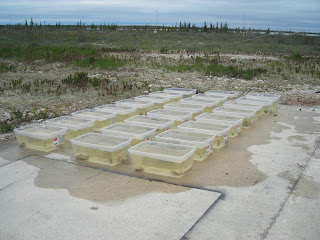
...but 11 years later I am still adding salt to things. So in the spirit of scientific discussion, let me share one of the experiments I am setting up here in Churchill. From last year's field season I have an understanding of the resilience that zooplankton communities in a metacommunity system show towards manipulated salinity, most likely because of dispersal from nearby, non-manipulated areas. What I don't know much about is how the role of sediments, or more specifically resting structures within the sediments (the things zooplankton produce to overwinter or when conditions aren't favourable) influence this resilience. To test how easy it is for Daphnia ephippia to emerge under various salt conditons, I have set-up my own "mini bluff" just outside of the centre.


Like Da Bluff, this site is also frequented by Da Bunny (although I doubt it is the same one we spotted frequently last year).


Basically, I have extracted ephippia (see my previous post) from various habitats, cold shocked them and then rapidly dried and rehydrated them to induce emergence (simulating the passage of a winter season). Now I have put them into small microcosms under various salinity conditions and will monitor emergence. In addition to control microcosms there are three other aspects that I am testing.

1. I'm interested in knowing whether ephippia gathered from different environmental conditions (i.e. freshwater, brackish and salty habitats) will emerge at more or less the same time/ with the same success when placed under the same conditions (in this case freshwater). This is of interest because I have qualitatively observed differential timing of ephippia production between different environments.

2. Other studies (many based on Australian wetlands) have shown that periods of high salinity followed by low salinity (followed by high again) do not hinder ephippia emergence and in fact, disturbance sometimes causes increased emergence (the mechanism is still unknown). If I also find this pattern with my microcosms, this may explain why communities were able to still thrive under up and down regimes of salt addition last year.

3. While lab studies have tested the tolerance of adult stages of zooplankton to salinity levels, few have done any work on juvenile or resting stages. Therefore it is important to establish what the tolerance of these resting stages are.

Working with resting stages is pretty tricky. Even in lab conditions it can be difficult to induce hatching of ephippia and that doesn't factor in attempting to do this under almost natural conditions.

Anyways, this is the first of a series of experiments so we will see what happens (and whether my methods work!). I welcome comments and questions. On a final note, I'd again like to mention the wonderful Common Butterwort. Because they digest crawling insects, they don't need much of a root structure and therefore can grow in unusual places. These ones are growing almost upside down at the side of a pool.

Thursday, June 10, 2010

Getting here...1 planktoneer arrived...2 to go

Well this edition of the blog is a spotlight on travel. There are many choices a researcher makes when planning a field season, some related to a project itself and others to logistics. One of the logistical choices I thought a lot about when planning this summer revolved around travel. Lately, I have been mulling over the implications of my research and have come to the conclusion that I want to be aware of both the academic impacts of my research (i.e. results and how I disseminate this information) but also the effect of how I do research. Doing research in Churchill when you are based at a southern Ontario university (actually when you are based at almost any university) means travelling substantially more than a short jaunt to get to your field sites. Churchill can be reached by air, train and sea travel (and technically by canoe as well...). Now as cool as I think arriving to Churchill via paddle or ship would be, neither seemed feasible this year so that left me with flying or the train. I opted for the train, and not just from Winnipeg to Churchill but from Toronto to Winnipeg as well.

(Map from VIA's website).


I felt this would be a good way to transition into fieldwork and get a chance to really appreciate the vastness that makes up the landscape between Guelph and Hudson Bay.


Here I attempt to share one an early morning scene on the tracks, just outside of Capreol, Ontario.
Guelph is about 1957 km from Churchill...but of course that distance is if you could travel in a straight line. The actual distance travelled by train takes in a few more turns.While some of these km may seem desolate, the history of the train line is far from sparse. At rest stops along the way I was able to learn a little more about the railway. For instance, I learned that starting in the early 1900s, most railway stations had elaborate railway gardens, set up as showpieces that would be the first thing passengers would see as they entered a new community. The point of this was to encourage passengers in rural parts of Canada. I enjoyed the train and really do feel that it is a method of transportation worth supporting.


Since arriving in Churchill, I have delved into another research season as a planktoneer...

(Photo: taken by Krista Hanis)


and have been slowly been regaining my bluff legs. As a recap, my project focuses on freshwater zooplankton communities along the coast of Hudson Bay and how they respond to changes in environment, most notably, the saltiness or salinity of the water. This year I am really interested in how the resting stages of zooplankton ( for example, this Daphnia ephippia below- I also like describe them as dumplings) may impact zooplankton's ability to recover from disturbance and stress.


The pouch like things pictured above are essentially dormant eggs released by mature Daphnia. And this is how our spotlight on travel fits in...Last year I spent a lot of time thinking about how zooplankton might "commute" around the rock bluffs without thinking much about the idea that sometimes it is easier to stay put and just wait out unfavourable environmental conditions- more on this later.

Well my arrival back at the CNSC has been filled with science, catching up with friends from last year and enjoying some very hot spring weather. I'm looking forward to the rest of the summer and many more planktoneer adventures in this place where there is always more to learn.


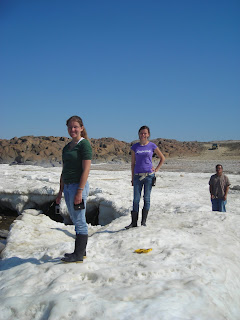
Below are some pictures of some coastal exploration with some of the other researchers from Guelph: Liz, Emily and Jinjing.

This is a specially crafted snowball...it has pieces of ice for extra protection...