One of the great things about being a grad student in a lab or research group is the dialogue you have with other grad students. Ingrid (one of the original planktoneers), has been away at Lakehead University this semester planning her PhD project and taking an environmental ethics course. She has provided some initial insights here. I enjoyed reading this post and thought I'd write a response or perhaps more of a continuation.
I think that another aspect that we have to consider in science is really how we do it and what we do with it once it has been done. I agree with Ingrid that we need to think carefully about what we are studying and why, because ultimately our science is going to have to stand for itself in the world and it is true that breaking down natural systems into measurable units may indeed detract from their instrinsic value.
However, I too feel that scientists have a role to play in environmental decision making and I think part of that lies not only with the ecology and the thinking behind it but also in the methods and application. The world is complicated. There are a lot of problems. We can discuss that forever and not get closer to solutions (we could probably also debate the meaning of the word "solution" for an infinite amount of time as well...), but there comes a point in time where we make a decision to study a problem and maybe even make recommendations. Regardless about where you stand on the second point, I think many of us can agree that all science has an impact. By impact I don't necessarily mean the impact that we want our research to have (ex. curing cancer, protecting an endangered species etc etc). I mean, obviously that is an end goal, but along the way our research will have other impacts: social, economic, environmental...impacts that we haven't even thought of.
I have been fortunate enough to work in the north for my MSc. I think the system I work on (aquatic rock pools) is important and that the problem I am interested in is equally applicable. But I also know that for every small bit of research I do, for every spreadsheet I have compiled and for every p-value I have gained through R there has been a train or plane that I took to Churchill and some soft tundra that I have repetitively compressed with my truck. This is why I think it is important for scientists to think more broadly about their research and ask important questions, not just research questions, but questions about how they are going to do research with the least amount of negative impact possible, and how they will ensure that their research reaches the audience it needs to after the fact (or during).
Alas, not sure if I have a picture that goes with this posting...
Sunday, October 31, 2010

Wednesday, October 6, 2010
Let's Talk Science
There are many opinions on the role of scientists in education and outreach programs. This is a discussion that happens routinely in my lab, and the Cottenie lab website has postings that cover several topics of science and education. I think that these discussions are important to have and I have certainly changed the way I view science education over the last few years because of them. But sometimes, we have to abandon the discussion (or put it on hold for a while) and just get out there and do something.
Marina and I recently started volunteering with the program Let's Talk Science. This organization runs may different education and outreach activities and is unique in that it is powered almost solely by graduate students! Filled with ideas of things we would like to do with LTS, we realized that we needed a small project to start with. Enter Karl's oldest son's first grade science class! Next week, we will be facilitating a workshop for four grade 1/2 french immersion classes (don't worry we are permitted to talk in english- we double checked!) at a local Guelph public school.
Our theme is "The Wonderful Word of Microbes" or all things small, and one of our main focuses is on bacteria and viruses, both good, bad and just plain germy. In preparation we have been testing some interactive activities, mostly involving UV lamps and we are looking forward to the real deal next week.
So whether you believe promoting science education is important, or think interactive learning is the way to go, stay tuned for an update how our session with the students goes!
Marina and I recently started volunteering with the program Let's Talk Science. This organization runs may different education and outreach activities and is unique in that it is powered almost solely by graduate students! Filled with ideas of things we would like to do with LTS, we realized that we needed a small project to start with. Enter Karl's oldest son's first grade science class! Next week, we will be facilitating a workshop for four grade 1/2 french immersion classes (don't worry we are permitted to talk in english- we double checked!) at a local Guelph public school.
Our theme is "The Wonderful Word of Microbes" or all things small, and one of our main focuses is on bacteria and viruses, both good, bad and just plain germy. In preparation we have been testing some interactive activities, mostly involving UV lamps and we are looking forward to the real deal next week.
So whether you believe promoting science education is important, or think interactive learning is the way to go, stay tuned for an update how our session with the students goes!
Planktoneer's write too? Well. We'll see about that.
My first experience in the Cottenie lab started 2nd semester of 3rd year when I worked on a semester long research project using data collected in Churchill that previous summer (2007). While I finished that research project course what seems like ages ago...I should have known that just as nothing in ecology is cut and dry, neither is the process of academia.
Academia, now there is a word that I don't slip into casual conversation everyday (well actually I probably use it far too often...something I'm sure my housemates could attest too). Now according to Wikapedia, "Academia" refers to "the community of students and scholars engaged in higher education and research." Well I've always known that there was a lot of that going on on the 2nd floor of the science complex, and beyond...but Monday I officially entered the world of academia...well at least I sent in my membership application, i.e. I submitted my first manuscript.
So now I am waiting to find out if I will get to undergo the initiation ritual of the peer review process, or if my membership card will get "lost" in the mail...
Stay tuned for updates and perhaps a summary of the manuscript, so that students I have been working with for the last few years no longer have to ask, "so what do you do again?".
Academia, now there is a word that I don't slip into casual conversation everyday (well actually I probably use it far too often...something I'm sure my housemates could attest too). Now according to Wikapedia, "Academia" refers to "the community of students and scholars engaged in higher education and research." Well I've always known that there was a lot of that going on on the 2nd floor of the science complex, and beyond...but Monday I officially entered the world of academia...well at least I sent in my membership application, i.e. I submitted my first manuscript.
So now I am waiting to find out if I will get to undergo the initiation ritual of the peer review process, or if my membership card will get "lost" in the mail...
Stay tuned for updates and perhaps a summary of the manuscript, so that students I have been working with for the last few years no longer have to ask, "so what do you do again?".
Wednesday, September 8, 2010
As the dust settles...
If there is one thing I am learning throughout my MSc it is that science doesn't always go the way you expect it to. Personally, I think that is half the fun but when I think about some of things I have done over the last few years and some of the results I have generated (sometimes in error) as I learn this process called science I can't help but think that maybe this is why scientists are sometimes viewed as "crazy" by the general public.
Well in the interest of pointing out that science is a process; a long, tedious but fascinating process and to show that those who work in science make mistakes, I have 2 images to share today.
These are the first two exhibitions in a series I'd like to call "hmmm, something seems off here...?".
Making mistakes, doing things the hard way etc is part of the process. It is what makes grad students into future scientists (ahem hopefully filled with integrity and critical thinking skills) and threatens our insanity all at the same time.
Exhibit 1: One of my favourite R outputs
I like stats, I'll say that right now. I dislike learning R and I'm ok with admitting that. But even in this cloud of bitterness I can see its utility and have warmed to it. My "favourite" warning message ever went something along the lines of: "Warning message- results may be meaningless in Bray". Well thank you R for completely dashing my aspirations of statistical signifiance. At least when you fall in R you fall hard and this makes you determined to not make the same mistake again. This means I will never forget to check for colinearity again, and because of this I'm sure that one day R will say "Your data is just perfect, great job!". Ok maybe not...perhaps this will inspire me to one day have the skills to write my own package that will say just that.
But even this warning message was beat this summer when I began to experiment with the commerical version of R. One of the first things I was working on in R was making a simple boxplot for my cosm experiment. On the x-axis I wanted experimental treatments and the Y I wanted emergence success. Here is what I got the first time around:

Intriguing though right? Like I would hang this on my wall as an abstract piece. Would you believe that all I had to do to create this (absolutely useless) masterpiece was to switch the x and y axes? Once I switched them back this transformed into a readable boxplot.
Intriguing though right? Like I would hang this on my wall as an abstract piece. Would you believe that all I had to do to create this (absolutely useless) masterpiece was to switch the x and y axes? Once I switched them back this transformed into a readable boxplot.
Exhibit 2: And then there were worms...
As part of my colleague Anne's (the shore bird researcher from Trent) work this summer she was measuring invertebrate biomass in the mudflats where SEPLs were foraging, to see if peaks in biomass conincided with chick hatching. This may sound simple, but when you are identifying insect larva to family level and then using specific equations based on individual measurements of individual specimens to calculate said biomass you end up with something that looks like this:

Now this is for 5 individuals of a single sample. Tedious? Yes. Accurate? Yes, and probably more so than drying and weighing the samples. I'll look forward to featuring this publication once this work at Trent University is done.
Saturday, August 21, 2010
My time is coming to a close...but not yet!
Well I wasn't sure that I would get a final blog in before leaving but as we are looking at a 12 hour train delay here the time seemed right for a summary and some thank-yous.

I've had a very productive and enjoyable field season this year, and really got a chance to be a part of the larger community up here. Thanks to Brittany and Leah, field team extraordinaire! Thanks to the ladies of S3 and the "warm" lab for keeping things fun, you really made this field season unique! Thanks to the staff at the CNSC for all the incredible work they do...without the support of the CNSC there are many research projects (including mine) which would not be possible. I appreciate all the hot meals, help with vehicles, cleaning, advice, general mentoring, field assistance and all of the other hats you wear! And finally, thank you to all the other researchers with whom I shared laughs, stress, mosquitos, fog and space with this summer. I can't wait to hear the results of the various projects in progress this year.
And now for some numbers:
- Days spent on a train heading west and north: 4
- Days spent on a train heading east and south: 4 (fingers crossed!)
- Days in the field: 82
- Egg and cheese breakfast sandwhiches: 70
- Bag lunches: 30
- Total water samples: 647
- Total km biked: 536.4
- Times swimming in Stygge Cr.: 10
- Times in S3 shower (notice the discrepancy): 8
This summer has been another season of learnings, and has given me a lot to think about, about my own science but about this place and life in general. I appreciate this immensely.
I was very fortunate this week to attend two events different than the rest of my experiences this summer.
CNSC Annual General Meeting
Wednesday was the CNSC's AGM, held in town and open to researchers, students, visitors and community members along as members of the Board of Directors. It was interesting to attend and learn more about the "behind the scenes" operation of the CNSC. In addition to the staff that work tirelessly at the centre there is also a dedicated board of directors made up of professors, community members and other interest groups. These individuals are also committed to the success and long term sustainability of the CNSC, something you don't necessarily think about as a seasonal researcher. With changes in government, funding and the environment this is an important time to be doing research in the north and I feel very privileged to have worked in Churchill these past couple years. Because of these experiences I have a greater appreciation for the difficulties associated with field ecology and especially fieldwork in a remote or northern area and feel inspired to make sure that everything I do in such places counts. This means thinking about the environmental/social impact of my work as well as improving the way I communicate my plans/results to others.
Summer lecture series presentation on "Place attachment in Churchill, MB"
Thursday night included a lecture by Dr.Patricia Fitzpatrick from the Dept of Geography at the University of Winnipeg. She did a a very thought provoking presentation on the concept of why people choose to live where they live using Churchill as an example. Not only was it interesting to hear some of the results of her research, it was also neat to think about how you quantify and analyze data that includes opinions and feelings.
-
Christmas Lake Esker
All in a days' work...
Had the opportunity to explore some more inland today after spending the majority of the summer on the coast. Hiked to Christmas Lake esker today and as much as I love the ruggedness of the bluff, heading inland also has it's appeal. Today we saw 3 caribou, an intricate fox den, at least 10 different types of mushrooms and a multitude of raspberries, blueberries and black currants. I feel very appreciative that after a few summers in Churchill I still see new things.
My fellow hikers took some great pictures and I will hopefully post a few group ones soon, but for now here are a few of the general scenery.

A bowl-like mushroom.
Lundy's cabin...what a front yard! Not used (as far as I know) anymore and because it is now located in the Wildlife Management Area it cannot be sold out of th family (though I imagine there would be offers).

The esker, there is a road along the top that you can take all the way out to Gordon Point.

Sunday, August 15, 2010
Feels like fall is upon us...
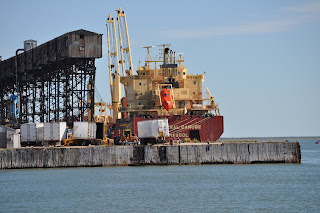
Well the last few days have brought temperatures just scraping into the double digits as well as wind gusts up to 70km/h. Myself, Emily and Liz spent most of the day yesterday on the bluffs collecting some Daphnia for one of my committee members at the University of Oklahoma. While these Daphnia have no idea, they are about to embark on a plane ride to Winnipeg and then Guelph before being rushed across the border by FedEx. They also have no idea that it can take an entire morning just organizing a shipment of water samples with the FDA! While out on the bluffs yesterday we noted that seaspray from the waves was reaching a good 200m inland. Two grain ships are anchored in the bay waiting to enter the port and I definitely would not have wanted to be at sea with yesterday's wind! According to the Manitoba Goverment, grain shipments comprise 90% of activity at the port!
With 2 weeks left in the field season I am busy getting sampling and experiments wrapped up and logistics sorted out for the trip back to Ontario. August is flying by but I've had several opportunities to take a break from my work and do some other things around the CNSC.
Showing my mom around the bluffs (my parents visited for a week and were put to work).

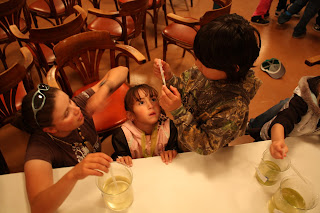
Showing some zooplankton to kids from the summer rec program in town (photo cred: the talented Leah Olivier).
Helping Krista and Leah haul palettes in the fen. Krista is building a boardwalk out to her flux station to reduce the environmental impact of accessing the station everyday. Thanks to Krista for this photo.

The transition going on out on the tundra is really noticeable right now, the colours are different and the air has a different feel to it. Well back to some data analysis and R...another part of wrapping up a field season, getting ready to actually use the data you have spent months collecting!
Subscribe to:
Posts (Atom)